
By Jo McEvoy
The Disruption of Polite Society
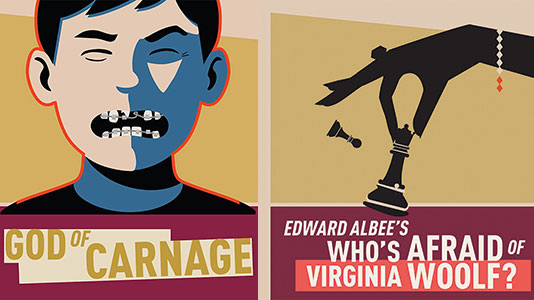
There is nothing quite like the feeling of discomfort in a new place—the collar of your shirt pulls in a new, itchy direction, your palms sweat in a way they never quite do otherwise, or perhaps you get a bit queasy. The invitation into a space that isn’t quite meant for you is one of life’s simplest displeasures.
Lisa Rothe, director of Who’s Afraid of Virginia Woolf?, and Marco Barricelli, director of God of Carnage, bring two worlds of drastic difference together in the same living room set. Meticulously designed by Regina Garcia, the set will shift each night to bring the audience into two separate homes: the downstairs of Martha and George’s collegiate home, the academic austerity of the 1960s on full display, and Michael and Veronica’s living room, replicating the quiet, easy luxury of modern-day New Yorkers. As the audience, we are forced to confront the spectacular disconcert of newness through the lens of the invited guests within Who’s Afraid of Virginia Woolf? and God of Carnage.
Barricelli and his cast spin a delicate web of polite society—Michael and Veronica do their hospitable best for Alan and Annette, strangers in every way except for their sons and the playground fight that ignites the events of God of Carnage. As the audience, we experience their world as Michael and Veronica have intended us to see it– pristine, a tasteful home for a put-together family. As the play unravels, their expectation of manners slowly gives way to the truth; the characters begin the show by believing in the power of communication and education as a reaction to the tactless violence of an 11-year-old, but the adults themselves finally give way to schoolyard bullying.
Barricelli utilizes a powerful staging of the characters that focuses first on their most polite selves; Michael and Veronica are confident but considerate, while Alan and Annette perch and hover. As the show inevitably plays on, the staging reflects the playwright’s language. “I believe in a god of carnage. He has ruled uninterruptedly since the dawn of time,” asserts Alan (played by Brian Vaughn), the rules of society long-forgotten as the characters let their base instincts take over their body language. This unraveling is not only for the characters, but the audience too, as we witness the inevitable disorder and the possible justification of the two couples’ turmoil.
In complete contrast to God of Carnage, Rothe exposes the audience to the world of Who’s Afraid of Virginia Woolf? in an esoteric setting that seems to breathe with an intimate personality. The books on the shelves are well-read, the liquor on the bar cart will be drunk. Martha and George stumble into their living room, sharing a joke that the audience isn’t quite in on, and we immediately understand that social expectations operate differently here. In the moonlight, at two in the morning, we are seeing a different side of society altogether.
Not only are we, as the audience, left out of the intimate affairs of Martha and George, but also the party they just returned from, where they have met the eager Nick and Honey, and who have been invited over for another drink. The already-inebriated young couple feel their own measures of discomfort, but quickly find their place of disruption in a home that is not theirs. Kim Martin-Cotten (as Martha) and Brian Vaughn (as George) work together brilliantly to build a life outside of the audience’s purview, a deeply complex relationship explained through highbrow social politics. Rothe has built this world to be experienced in a very bodily and emotionally invested way. The dynamics at play are a game determined by the onstage characters, and Rothe’s rendition of Albee’s work invites a willing audience to participate.
Both God of Carnage and Who’s Afraid of Virginia Woolf? pair together beautifully, showing off the spectacular clash of devolving societal expectation and the intimacy of life behind closed doors. The Rep at SCR this season breathes a new life into two highly regarded works, inviting their audiences into a world of disintegrating social politics to reflect upon our state of ever-changing civic standards.